Large turnout in Wageningen at protest against budget cuts
At least two thousand demonstrators took part in a long portest march through Wageningen. Both teachers and support staff, as well as students and other stakeholders, are taking action today against the cuts in higher education.

At least two thousand protesters took part in the action in Wageningen. Photo: @mediaapostles
Today, on the field in front of Wageningen University, the sixth week of the relay strikes against a 1,1 billion cut in education - half a billion of which in higher education - kicked off. Babette Nijman, receptionist at the university building Forum, walks onto the field with colleagues, where several hundred activists are already standing. She has come to make her voice heard, because she notices that the cuts are already being anticipated.
“The support department is already being cut. There will be no forced redundancies, but it is already clear that I will have to go somewhere else. That is a shame for me, I will miss the contact with colleagues and students, but the worst thing I find is that this is at the expense of quality. The workload is already high, it means that not everything is possible anymore and people have to wait longer. I think it is good that they are looking at how it can be done more efficiently, but this is very rigorous.”
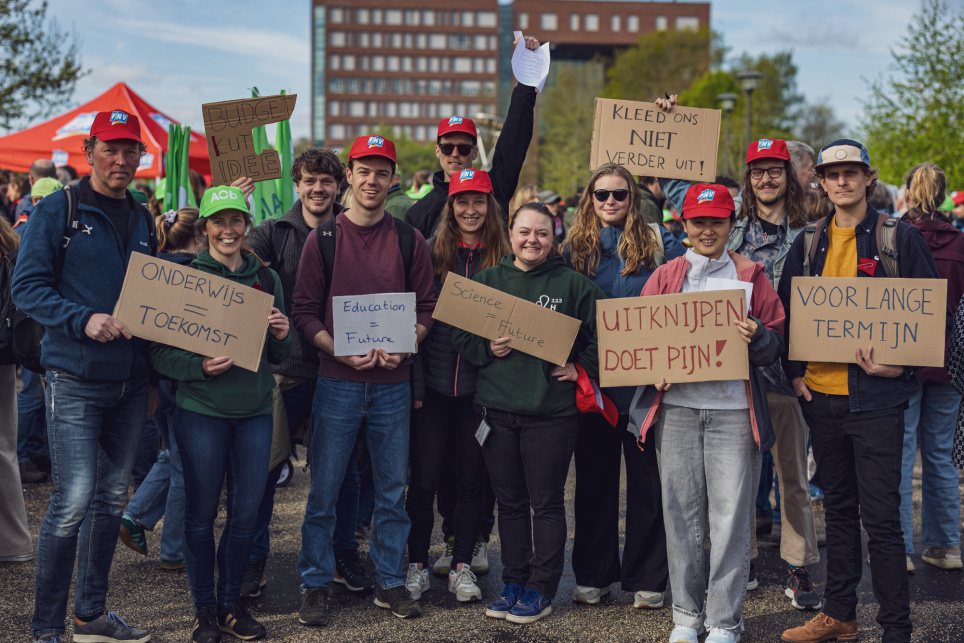
Lecturer Michiel van der Molen and senior lecturer Ingrid Luijkx (both left) with colleagues from the Meteorology and Air Quality program. Photo: @mediaapostles
“Wageningen is on strike. Not because we don’t want to work, but because we want to keep working,” Sjoukje Heimovaara, chair of the Executive Board of Wageningen University & Research, calls out to the audience. “You can’t put 85x innovation in your government program and then cut back on it. Innovation doesn’t fall from the sky, it requires investment. For the teacher, for the student, for the programs we say: Don’t do it.”
Does the government think about what kind of society we want to be?
"Don't do it”, the crowd chants as the protest march moves towards the city centre. Lecturer Michiel van der Molen walks along with colleagues from Meteorology and Air Quality. “It is unbelievable what is happening. The Netherlands earns money with innovation and technology, but due to the cutbacks there will soon be no more people to make this happen. And this while the substantiation for these cutbacks is lacking. Is the government thinking about what kind of society we want to be?” “Education is our future”, his colleague and senior lecturer Ingrid Luijkx adds as she holds her protest sign with this text a little higher.

Senior lecturer Madelon Lohbeck: "Together we are stronger." Image: @mediaapostles
Further down the row, senior lecturer Madelon Lohbeck holds a sign on which her six-year-old son has written: 'Boe mienister Bruins'. "I also stand here for the future of all children who still want to study," she says. "I think it's great that we are showing that all universities form a movement, together we are stronger and we can achieve more. If cuts have to be made, I hope that the board makes the right choices, so that nothing disappears that cannot be restored."
Science knows no boundaries
After almost 4 kilometers, the procession - now grown to about 2000 demonstrators - arrives at the market. "These cuts, but also laws against internationalization, ultimately mean that politicians will determine what free science is, and we must never let that happen," says mayor Floor Vermeulen, after which loud cheering breaks out.

Ignas Heitkönig and Babette Nijman. Photo: @mediaapostles
Ignas Heitkönig stands in a colorful lab coat that he received at his farewell from his chair group Wildlife ecology and conservation. “I am here because I am very angry about the government’s choice. Science knows no boundaries, so limiting the influx of international students is an absurd measure. And disastrous for education. We are already noticing the cutbacks. The buildings are closing earlier, which makes informal contacts less possible and extramural education is under pressure.”
The connection is something that Hanna Elsinga, chair of the student council and student of Business and Consumer Studies, also works hard for. “Alternative teaching methods are essential because they create the link with practice. In addition, it is important that everyone gets the chance to study and that we keep the connection alive. In Wageningen, all disciplines are linked to each other, it is precisely that exchange of information that makes it interesting.”

Hanna Elsinga (right) and fellow students. Photo: @mediaapostles
“What happens in Wageningen is of vital importance,” Rosanna Funnekotter, coordinator of labor participation at the university, emphasizes from the stage. “WUR is a university where differences are celebrated, where 170 different nationalities and cultures come together. Making and keeping research and education accessible takes time and money.”
These excessive cuts are putting equal opportunities at risk
"These excessive cuts are putting equal opportunities at risk," she continues. "In a time when disinformation is on the rise and democratic values are crumbling, we need more. More space for education, more research, more diversity and inclusion and above all: more space for free thinking. Every euro that is cut is a step backwards for the future." At her request, the audience then holds hands. "Let this be a powerful symbol: Don't do it. We will not take a step backwards!"
AOb-director Donald Pechler thinks it is great to see how much solidarity there is. “All universities are making their voices heard. Together we form a broad coalition to convince politicians to reverse the cuts. We will continue to campaign in the hope that the education budget will be adjusted in the Spring Memorandum.”
There is still a strike in Maastricht (April 16), Eindhoven (April 23) and Delft (April 24).
The actions continue. Stop the destruction of higher education! Join


