Higher education faces 'hot autumn' if cuts continue
A sun-drenched Domplein in Utrecht was today the scene of protest against the 'bitter wind' that threatens higher education and research. Hundreds of students and staff kicked off the resistance against the coalition plans to cut one billion euros per year.

Roland Pupupin
“If the cuts are not taken off the table, we will call the most disruptive strike in Dutch education ever. At the most precarious moment, with the most impact.” Of all the speakers on Monday during the Alternative Opening of the Academic Year on the Domplein in Utrecht, Rens Bod of WO in Actie is the most verbally aggressive. “Of course in consultation with the unions, no wildcat strike,” he adds.
“We are considering further actions, that goes without saying,” FNV director Bas van Weegberg said afterwards. What exactly these will look like will become clearer in the coming period. With Budget Day, there will be more clarity on how the cuts will work out.

Image: Roland Pupupin
Baldness
There has been great unrest in higher education since the coalition of PVV, VVD, NSC and BBB announced a series of cuts (see box below) in their main program for higher education and science last May, which together amount to around 1 billion euros per year. That is why eleven organizations, including the AOb and FNV, joined forces to oppose these plans to fightThey fear a bloodbath, with many jobs at stake and the accessibility of higher education at risk. The protest demonstration this Monday during the alternative opening of the Academic Year is a first step in that resistance.
We all need to send a clear signal
While the Domplein is already filling up, Siebe Bluijs is patiently waiting. “Why am I here? Because I am very concerned about the impact that the cutbacks will have. We all need to send out a clear signal,” says the university lecturer and teacher trainer of Dutch, affiliated with Tilburg University. He points to the investments of the previous cabinet, with agreements laid down in sector plans that are now being jeopardized again. “That was overdue maintenance, it was badly needed, many people were hired thanks to that money.” Bluijs is affiliated with the Tilburg Center of the Learning Sciences, which has now acquired a stronger position within the organization. “We are afraid that things will deteriorate again soon.”
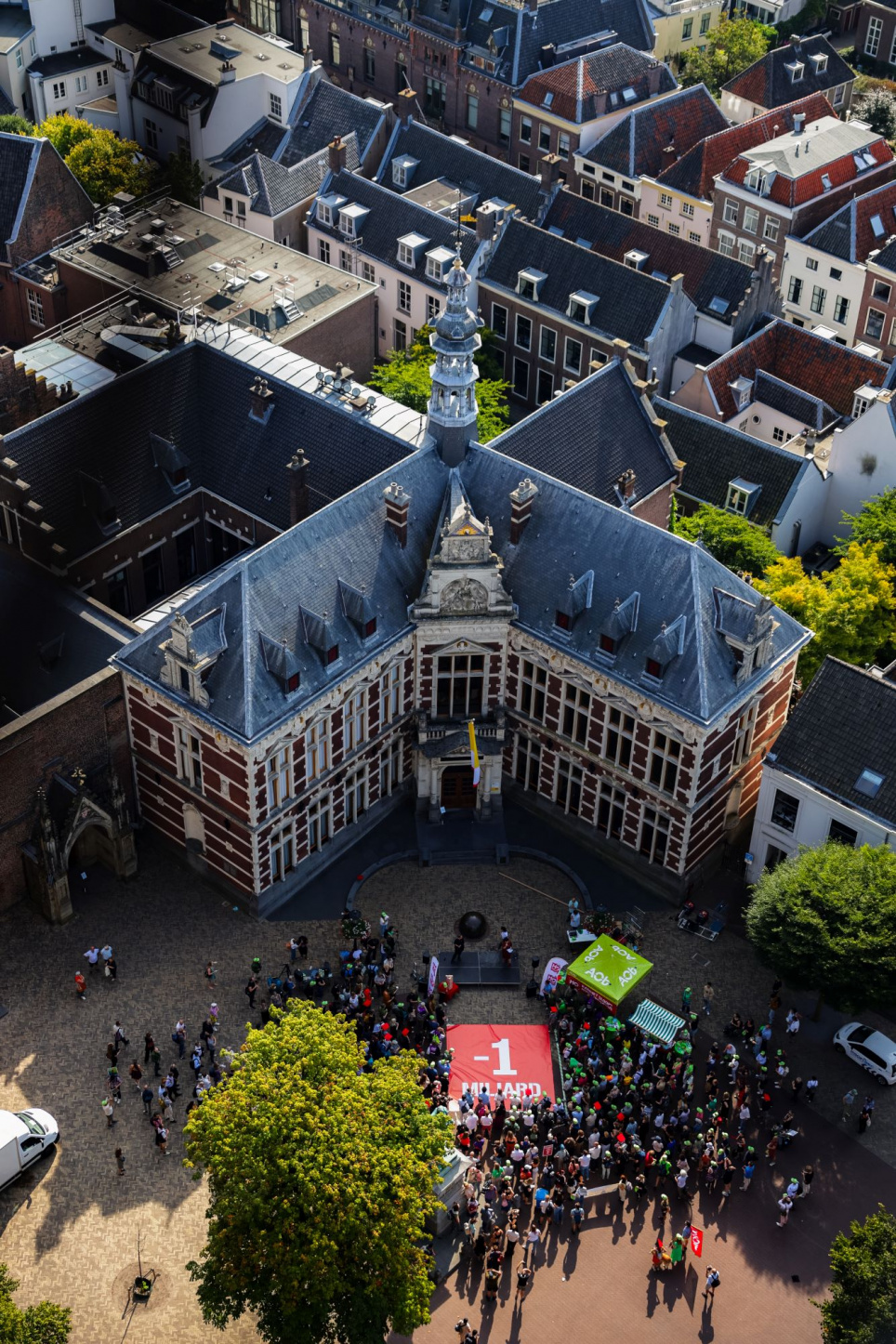
Image: Roland Pupupin
“This is improper management,” says AOb-chair Tamar van Gelder the coalition plans from the podium. "That makes the government unreliable. A cold wind is blowing through The Hague. If the cuts remain, we will ensure a hot autumn."
Everything that is being destroyed now, we may never get back
"The government is shooting itself in the foot with these cutbacks," says Caspar van den Berg of Universities of the Netherlands. "At least five thousand jobs are at risk due to the plans of this government. Everything that is now being dismantled, we may never get back."

Image: Roland Pupupin
Fat wallet
The blow is widely felt in higher education, including in higher professional education. “We are standing here today together, with you,” says Maurice Limmen, chairman of the Association of Universities of Applied Sciences. He refers to the announced fine for long-term study and how it is already affecting the considerations for whether or not to choose a particular study. “Many people in higher professional education are also very concerned about this. The damage from the announcement of the fine for long-term study is already there.” According to him, the punitive measure, with which the coalition wants to save almost 300 million euros per year, is unfair. “It specifically affects the students who cannot call home to parents with fat wallets.”
Many speakers and attendees place the cabinet plans in a broader perspective. “I try to see it in a broader context,” says university lecturer Bluijs. “Cutbacks in higher education, public broadcasting, journalism… places where critical thinking takes place.” Laura Hoenig, social psychologist and postdoc at the VU in Amsterdam: “This is not just about financial choices, but also about something broader. It is a deliberate tactic of the right to cut back in places where free and critical voices can be heard.”
“The deforestation in the public sector is no coincidence,” says FNV director Weegberg. “Let us show solidarity with other targets of this coalition.”
Would you like to be kept informed, without obligation, about the continuation of this campaign? Please provide your email address!
Minister: 'Financial choices are necessary'
The main lines agreement of PVV, VVD, NSC and BBB threatens to cut a billion euros annually from higher education, research and students through various measures. 215 million will be taken away from the sector plans, 300 million euros will be cut from 'long-term students' and approximately the same amount will be 'booked' on reducing the number of international students. On top of that, 1,1 billion euros will be taken away from the research and science fund, the latter spread over seven years.
The coalition agreement is being elaborated by the cabinet in a government program. Budget Day must make clear what the cuts will look like in the coming years. 'I will take the concerned signals from the field into account', Education Minister Eppo Bruins announced last Thursday to the House of Representatives. The minister acknowledges that the cuts will affect many organisations and institutions. 'I expect that the cuts in higher professional education, university education and science will also have an effect on other knowledge institutions, knowledge partners and companies with which universities collaborate. I understand the concerns that are being expressed about this.' At the same time, 'financial choices' must be made to pay for all the cabinet plans, he wrote in response to parliamentary questions from GroenLinks/PvdA.


