All

7000 activists on Dam Square: 'Stop the demolition'

As the coalition government's formation process accelerated, thousands of activists gathered today on Dam Square in Amsterdam. Their message to the parties forming the coalition: don't cut back on higher education. The Education Journal interviewed four activists. "I feel I should remind Rob that education is a priority for D66."

Tekst Lisette Douma - Redactie Onderwijsblad - - Minder dan een minuut om te lezen

"I'm afraid of what else will break"

Niklas Abel-Hardenberg is a lecturer and PhD candidate at the University of Groningen, the University of Amsterdam and the Amsterdam University of Applied Sciences:

I find the budget cuts appalling. Not just for me as an academic, but especially for the future of the knowledge economy. With the Balanced Internationalization Act, the Netherlands has already become the target of academic Europe, and I fear what else will be destroyed. I want to be very cautious about linking these cuts to a fascist agenda. But the humanities—which is what I work for—were dismissed as a left-wing hobby by our previous cabinet. Yet, looking back at history, it was the humanities that raised and tried to confront questionable policies. I fear we are at the beginning of a process that will undermine the quality of education and our democracy.

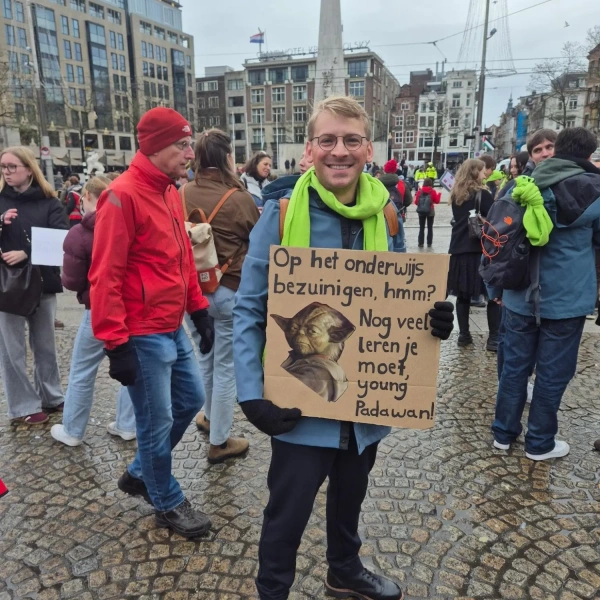
Protester with Yoda protest sign on Dam Square
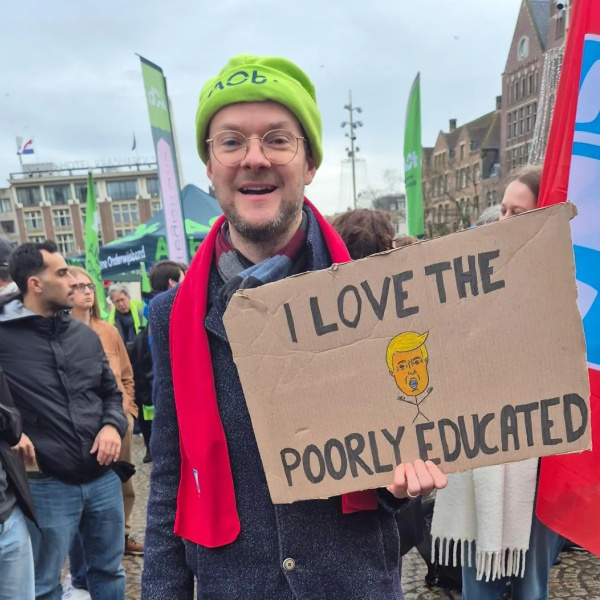
Protester with protest sign Educate not Educut

Opinions must be based on knowledge

Leonie Schorrlepp, PhD student at Tilburg University:

In the Netherlands, people don't simply accept things. The Dutch want to form their own opinions about everything. That's a good thing, but those opinions must be based on knowledge. That's now being compromised, and that's dangerous. I'm also hopeful, because I think we PhD students are quite well protected. But I want to stay in the Netherlands, and I wonder if there will be any jobs once I finish my PhD.

'I had hoped that the election outcome would be a one-two punch'

Eelke Spaak, university lecturer at Radboud University:

I found this promotional sign at the Jumbo checkout and thought it was too good to pass up. Kudos to the creator. To them, I want to say: 'Look, your sign has been well-received, and thank you.' I'm a D66 member and had hoped the election results would be a win-win for education. But now I feel I need to remind Rob that education is a priority for D66. Since the budget cuts were announced, I've already noticed that temporary contracts aren't being renewed and courses are becoming more austere. I can pursue my PhD with a starter's grant; for people after me – who were also counting on it – that grant no longer exists. Research is under pressure. Because there are fewer employees, everyone has to teach more, and students receive less individual attention. That's not good for the quality of both research and education. 

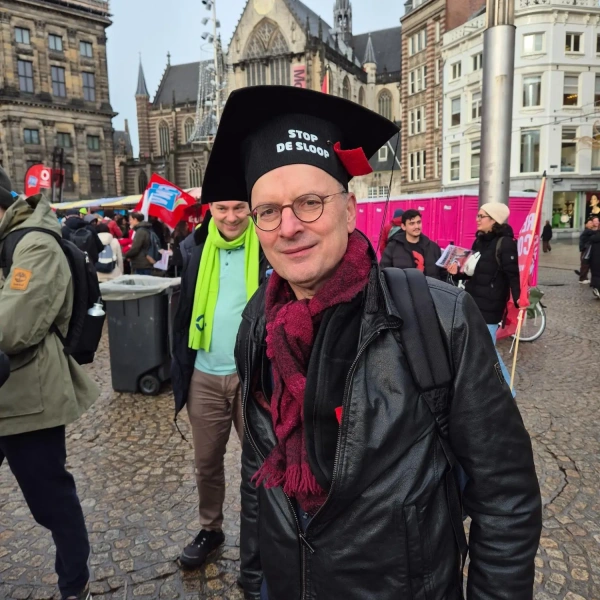
Man with protest sign at demonstration

'I am against the way in which cuts are being made'

Marcel Verweij, professor of philosophical ethics at Utrecht University:

When Robbert Dijkgraaf was Minister of Education, it gave us some breathing room; we got extra colleagues. Those colleagues all had temporary contracts and are now gone again. In Utrecht, we felt the impact of the budget cuts immediately. It's a bit of a double-edged sword: today, we might stand shoulder to shoulder with university administrators, but internally, we still have a lot of squabbling to do with them. I'm disgusted by the way the cuts are being made. It's purely about cutting numbers. Fewer than 15 students a year? Get rid of that program. Yet, as a faculty, you also have a role in society. For example, the Humanities department also offers courses on Islam and religion. The program might not be well-attended, but as a minor, there's a tremendous amount of interest in Arab culture, for example, from pharmacy students. At a time like this, Islamic culture is so important, so you can't just cut those kinds of courses.
Marcel Verweij

What was that again?

Since September 2024, the AOb Action against the cuts to higher education: the Schoof cabinet announced a €1,1 billion austerity measure. This was added to the Spring Memorandum and, after a successful protest against the elimination of the educational opportunities scheme, resulted in a total cut of €1,3 billion. For higher education, this represents a €491 million reduction. The cuts have already been approved by the Senate. Today, the (student) unions, WO and Actie, and other activist groups are protesting again. The goal: the next cabinet must reverse the cuts and invest more in education and science.

This page was translated automatically, if you see strange translations please let us know