Bridge year offers a safe stepping stone to secondary school
Not every student is ready for secondary school after the eighth grade. For them, Utrecht and Arnhem offer the Jan Ligthart Bridge Year, which teaches young people how to plan, present, and develop themselves. "Our goal is for them to move on to their next secondary school with confidence."
Tekst Rianne van der Molen - - 9 Minuten om te lezen
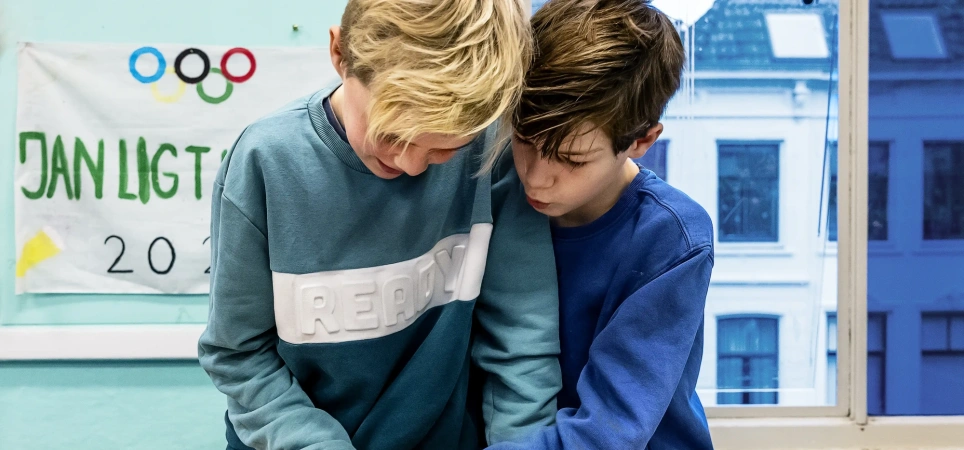
At the Waldorf secondary school in Utrecht, students participate in the Jan Ligthart year, intended for first-year students who have completed the eighth grade but are not yet ready for secondary school. Photo: Angeliek de Jonge
What's planning? A few students from the Green group immediately raise their hands. "That you do it at a certain moment," says one girl. "That you have your things in order," says another. Why is that useful, asks teacher Karlijn Veltman. Everyone can fill it out on their own laptop, and the answers appear on the digital whiteboard. "So you get things done," one example says.
The bridge year is not intended for parents who hope that the school advice will be adjusted upwards
These Executive Functions lessons are a key component of the Jan Ligthart Bridge Year, named after a Dutch educational innovator. These two classes—located in the Waldorf Utrecht free secondary school building—are for first-year students who have completed the eighth grade but aren't yet ready for secondary school. "Each child has a different reason, but it often stems from a lack of self-confidence," says Veltman, team leader of the bridge year and French teacher at Waldorf. "You're not here for sweaty feet; there's usually more to it than that."
A safe intermediate step
T1: In 2016, Veltman received a request from the board of the PCUO Willibrord Foundation, which includes Waldorf Utrecht, to establish a bridge year. Board members noticed that many students were dropping out in the first year of secondary school. The step often proved too big for them. "We were inspired by the existing Jan Ligthart Bridge Year in Arnhem, but chose our own approach."
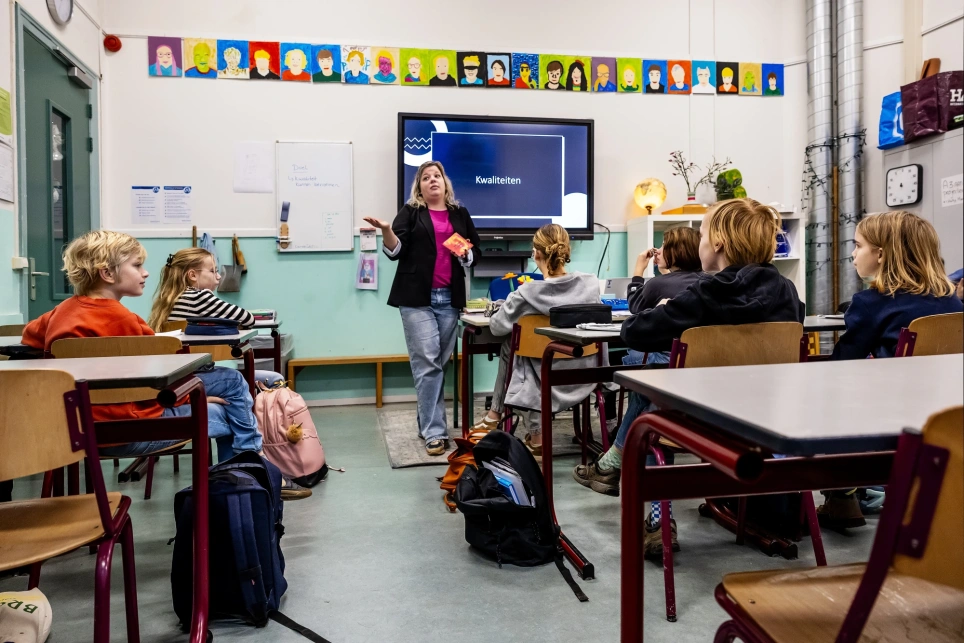
Learning to learn plays a major role in Jan Ligthart's Bridge Year, as do social skills, presenting and finding your role in a group.
The students attend classes at the pre-vocational secondary education (VMBO-TL/HAVO) level (Blue group) or the senior general secondary education (HAVO/VWO) level (Green group). They have their own classroom, which most teachers visit. "Learning to learn plays a major role, as do social skills, presentation skills, and finding your role in a group. There are also regular subjects like math, Dutch, and English." Many of the "Jantjes"—as Veltman likes to call them—were born between September and the end of January. In Green group, there are also a number of students who skipped a grade due to giftedness. "Our goal is to give them enough tools so they can confidently move on to their next secondary school."
Learning to learn plays a major role in Jan Ligthart's Bridge Year, as do social skills, presenting and finding your role in a group.
Beforehand, we discuss with the parents, the child, and the primary school teacher whether the bridge year is appropriate. "If the support needs are too extensive, it won't work. That's simply not manageable for us. We place children starting with a pre-vocational secondary education (VMBO-TL) recommendation, so that the levels don't differ too much."
In Utrecht, they started with 20 students in 2021. There are now two classes: one with 19 and one with 22 children. "We're noticing growing interest. We can still place everyone, but the information evenings are becoming increasingly well-attended." Veltman always emphasizes during these evenings that the bridge year isn't intended for parents hoping their child's recommendation will be upgraded. "It sometimes happens that a student scores better with us than on the final exam. But that's absolutely not our goal."
Social growth
One of the alumni of the bridge year is Michel (not his real name). In the eighth grade, his parents noticed that the transition to secondary school felt very big. "Michel had been diagnosed with ADHD and suspected autism," says his father, who, like Michel, does not use his real name. Education magazine wants to address this very personal topic. "He found the social aspect difficult. Moreover, he didn't feel comfortable in the eighth grade and was bullied a bit there. Michel wasn't keen on going to an even bigger school." His teacher pointed them towards Jan Ligthart. After a parent-teacher meeting, it immediately felt right. "We allowed him to take a gap year."
Looking back, Michel's father calls the bridge year a "rich" period. "It was especially special socially. Michel felt safe in the classroom; for the first time, he felt like he belonged. He'll carry that experience with him for the rest of his life."
In Utrecht they started in 2021 with 20 students.
He's since been diagnosed with autism spectrum disorder, and Michel has found a place in secondary special education. "Thanks to Jan Ligthart, we discovered this was better for him than a regular school. Michel went there feeling good. He now has a better understanding of how to learn, what to put in his bag, and has grown socially."
No idiots
Teaching in the transition year is a specialized field, says Karlijn Veltman. "The material itself is less important here; we mainly focus on how the student functions and processes it. It's about academic progress and well-being. Our core team consists of five members who teach a large portion of the lessons, so that ensures short communication lines."
All teachers set aside plenty of time for reflection. "Why do young people do what they do? Why don't they finish their homework? We discuss this together, but also with the students themselves. Sometimes they don't know, but that's not something they can get away with. We keep encouraging them to think."
As the year progresses, students walk more upright and their insecure sides disappear.
At the Jan Ligthart Bridge Year in Arnhem, which inspired the Utrecht Bridge Year, they've been doing this since 1955. Thousands of students took a gap year there. Team leader Wouter den Brok can roughly divide his students into three categories: "Young people with a disharmonious profile, who are good at math, for example, but poorer in language, or vice versa, students who struggle with planning and learning, and children with social-emotional challenges."
This school year, five classes started in the Olympus College building. Here too, about 50 percent of the student body consists of young students, and the focus is on building self-confidence. "At most secondary schools, the goal is to get a diploma. Here, the pressure is off. We do a lot, but not everything has to be finished." This appeals to teachers, Den Brok observes. When he advertises vacancies, he doesn't notice the teacher shortage much. He always has a choice, although not everyone is a good fit for the school. "If you're a stickler for the subject, you have no business here. You have to be a teacher first and foremost, and have strong empathy. We have students with challenging behavior. But that behavior is often a consequence of something else. The idea is that we'll discover that together."
Problematic environment
Back to class Groen, where they're watching a video about a couple going on vacation. What needs to be arranged, and how do they do it? Veltman says the priority matrix is a useful tool. Urgent and non-urgent are listed at the top, and important and non-important are listed below. "Come up with a task," Veltman asks. "Feeding the cat," says a girl. "Okay, is that important?" The girl nods. And urgent? "Yes, that too. Otherwise, the cat will die." So, the task is marked as important and urgent. Something best done first. "And watching a TikTok video?" Veltman asks. Very important, the students conclude. "But maybe a little less urgent?" A few girls laugh. "Isn't TikTok really urgent?"
With confidence to secondary school
Annemarie's daughter (not her real name) learned a lot last year during Executive Functions classes. However, Annemarie had some reservations about the gap year beforehand. "My daughter was young and always six months behind. In primary school, repeating a year was considered every year, but because she was emotionally strong, that didn't happen."
Isn't a year like this for students with a backpack?
The internal counselor pointed her towards the bridge year. "I thought: isn't that a year for students with some baggage? We didn't want her to end up in a challenging environment. Ultimately, we took the plunge, mainly because she was dreading secondary school."
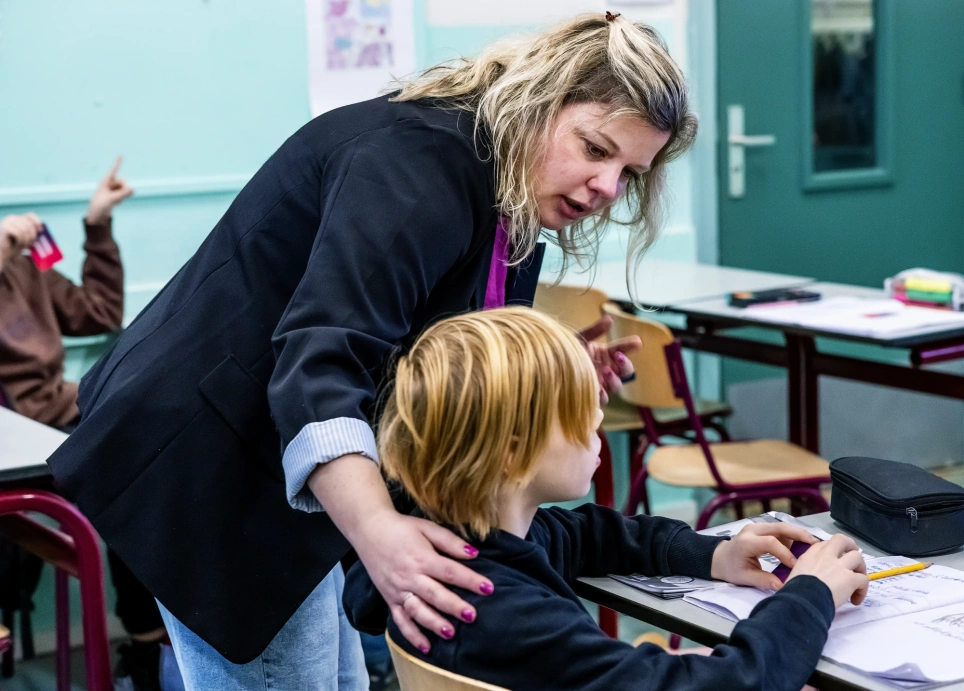
Team leader and French teacher, Karlijn Veltman: “Every child has a different reason, but it often stems from a lack of self-confidence.”
Looking back, she's happy. "Fortunately, it turned out to be a perfectly good environment, and she learned a tremendous amount. About scheduling, presenting, collaborating, and standing up for herself. She also caught up on her spelling, which allowed her to start high school with confidence."
Lack of time
Achieving this growth curve presents a significant annual challenge for teachers. "The hardest part is the lack of time," notes Veltman. Since the bridge year is included in the lottery procedure in Utrecht for the first time this year, there's a lot of pressure on file-building. Previously, teachers had to actively search for places for their students at the end of the school year, and there was a risk that bridge-year students wouldn't be placed in their chosen school. "Participating now is great for parents, but it's taking some getting used to for us. We want to ensure a smooth transition."
While a primary school can spend years discussing a student, Jan Ligthart needs to develop a clear picture of a child in just a few months. "That handover ultimately needs to include information about the student that will truly benefit the next school. This way, the teachers there don't have to reinvent the wheel."
Veltman knows that most of the former Jantjes have found a suitable place. "But the best part? I really see them grow. Throughout the year, the students become more upright, and their insecurities disappear. At the end of the year, I'm always impressed. Then I feel confident enough to let them go to another high school."
Other bridge years
Bridging years aren't limited to Arnhem and Utrecht. There are also options elsewhere, though they are slightly different in nature. For example, there are Intermezzo classes in Amersfoort, Nijmegen, Alkmaar, and Sint-Michielsgestel, specifically for gifted young people. Another option is Group 9 at the private Florencius educational institute in Laren, Haarlem, and Amstelveen. With a price tag of over €30 per year, it's suitable for a very small group of Dutch students.