If your student has a severe food allergy
Practicing an Epipen on an apple, a walnut found during an autumn walk, and a school trip involving potentially unsafe restaurants. For teachers and students with severe food allergies, the tension often lies in the details. “I pay extra close attention when I’m in front of the class.”
Tekst rianne van der molen - redactie onderwijsblad - - 7 Minuten om te lezen

Teacher Yvonne Coppens from primary school de Heiacker in Veldhoven and Juul (10). Image: Fred van Diem
“Do you remember when we went into the woods together?” asks Miss Djoeke Kunnen in the circle to the preschoolers of the Oosterwold Waldorf School in Almere. Many children nod. “What did we find then?” “Chestnuts,” calls one. “Acorns,” calls another. “And walnuts,” says a little boy with spiky hair enthusiastically. Miss Djoeke looks at him for a moment. “Very good. And what should we do if we find walnuts?” From many mouths comes the simultaneous reply: “Leave them!” The children know why. “You are allergic to them,” says a serious-looking girl with long dark hair.
Kunnen nods. Her allergy is a topic that comes up regularly in class. “When children really press me, I explain that I can't breathe very well if I get a piece of a nut or peanut in my throat and have to go to the hospital. I give them an honest answer, but deliberately don't make it too serious. You don't want the whole kindergarten class to be terrified when the lunchboxes are opened, because someone might have accidentally brought a peanut butter sandwich.”
I give them an honest answer, but deliberately don't make it too serious.
Thanks in part to teacher Djoeke and a few allergic children, the Oosterwold Waldorf School is completely nut- and peanut-free. Not everyone is in favor of such a measure. For example, Erna Botjes of the Food Allergy Foundation had this done in mid-August. The Telegraph It is noted that this creates a false sense of security, especially for severely allergic children. After all, outside of school, they visit many more places where they can come into contact with peanuts or nuts. As a teacher, Kunnen is actually happy with the choice her school has made. “It gives me a lot of peace of mind,” she says, after the kindergarteners have been picked up. Because when she ingests nuts or peanuts, she can have an anaphylactic reaction: a rapid allergic reaction with severe breathing problems, dangerously low blood pressure, and oxygen deficiency. Administering an adrenaline pen, commonly known as an Epipen, and calling an ambulance is then necessary. “I know for myself that I have about 30 minutes left from the moment the reaction starts, so there is plenty of time to administer the pen myself. But most of my colleagues also know what to do, and who takes over my class immediately. Fortunately, it has never happened, although I do pay extra attention when I am in front of the class.”
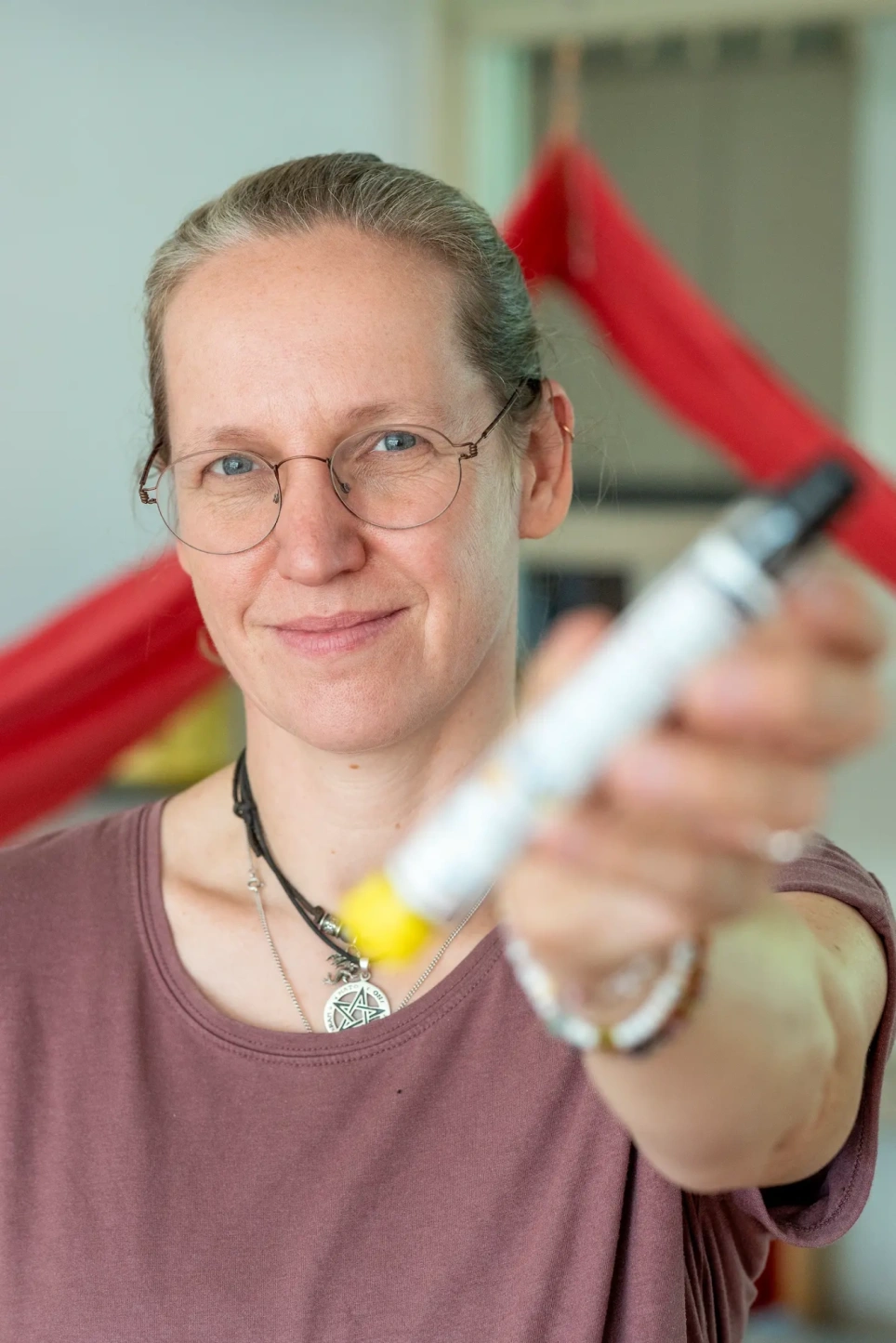
Thanks in part to teacher Djoeke Kunnen and a few allergic children, the Oosterwold Waldorf School in Almere is completely nut- and peanut-free. “It gives me a lot of peace.” Image: Fred van Diem
Poke the apple
Anyone is allowed to administer an adrenaline pen as an emergency treatment, but her colleagues are not legally required to do so. According to Beatrijs Timmermans of Anafylaxie.com, it is wise for schools with severely allergic staff or students to have a protocol for these types of situations. “Such an emergency plan provides guidance if something happens,” she believes. “By creating one, you can, for example, agree on who dares to administer an adrenaline pen and how the handover to substitute teachers proceeds.” For although teachers are not required to administer the pen, they are required to help someone in an emergency situation. “Anaphylaxis is an emergency situation. And you know what? Once you’ve administered such a pen, it often turns out to be much less serious than expected.”
Once you've done a pen like that, it's often not that bad at all.
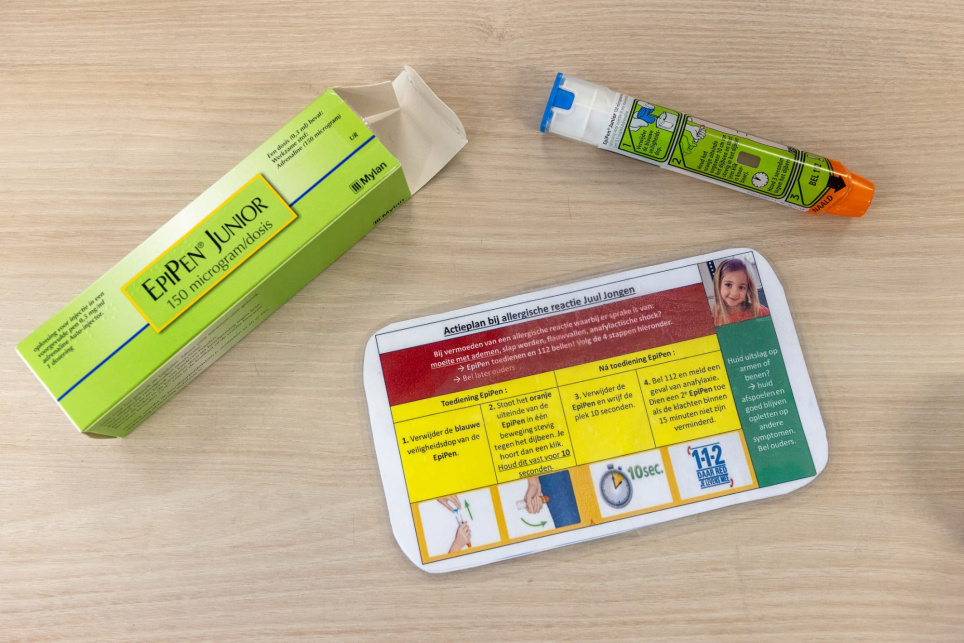
That is exactly why mother Jolien Jongen requests a meeting with that year's teacher at the beginning of every school year. Her daughter Juul (10 years old) is allergic to nuts and sesame. Teacher Yvonne Coppens of primary school De Heiacker in Veldhoven found it quite nerve-wracking when Juul joined her Group 7 last year. “But mother Jolien’s open attitude helped me. She immediately placed an apple on the table and asked if I wanted to put the Epipen in it. ‘Then you’ve done it once,’ she added. It went very easily and my fear immediately lessened a little. I felt: I can do this, if necessary.”
Coppens has Juul in her class again this year, but she has never experienced a reaction. Although there is no school-wide protocol regarding severe allergies, there is a clear schedule hanging in the classroom. “It states which teacher we are paired with. We have a sort of buddy system to support each other if something goes wrong. And when it comes to substitute teachers, Juul is always involved so she knows where to go if she has a reaction.”
Picture: Fred van Diem
Allergy or intolerance?
When it comes to allergies, there is sometimes confusion. For instance, a gluten or lactose intolerance is very troublesome and can cause unpleasant symptoms, but that is really something different from a milk allergy or celiac disease. With a milk allergy, even a small amount of milk can trigger an anaphylactic reaction, and with celiac disease, eating gluten damages the small intestine, making a strict gluten-free diet necessary. “I know the differences well,” says Corola Hintzen, a mathematics and physics teacher at Connect College secondary school in Echt. She is often called in when a student with a severe allergy is registered. “I have celiac disease myself, and if I accidentally ingest gluten, I get extreme diarrhea, stomach pain, and fatigue. I always want to prevent that. Because of my celiac disease, I understand children with food allergies well, as well as the fear that sometimes accompanies them. At the same time, I know how important it is for teenagers to be able to participate with the rest.”
One of her students is 16-year-old Enzo, who is allergic to cow's milk, nuts, eggs, peanuts, sesame, and soy. When his class went on a school trip to Italy in the third year, his parents had doubts. Could they really let him go safely? “I invited them to school, told them about my own celiac disease and that we have a clear protocol for students who might have an anaphylactic reaction. That gave them confidence. After that, we went through the entire trip and every meal. We were going to eat out once. If that didn't feel safe, we agreed that I would take him to McDonald's, where allergens are always well-managed. I take it very seriously, but I mainly look at what is possible.”
I take it very seriously, but I focus primarily on what is possible.
Not every teacher shares that view. An Amsterdam mother of a preschooler, who prefers to remain anonymous, has noticed this. Her son is allergic to cow's milk, eggs, nuts, bananas, apples, rice, and peanuts. When they were looking for a school for him, it wasn't easy. “Several primary schools found his allergies too complex and didn't dare take him on. Now he attends a school where the principal has a food allergy himself and welcomed him immediately. But he has a teacher who doesn't seem to take it entirely seriously. Sometimes I get the feeling that she mainly sees us as a nuisance. That feels unsettling every day, although fortunately things haven't gone wrong yet.”
If the tension is that high, according to allergy teacher Djoeke Kunnen, you are better off playing it safe. “That is what I teach preschoolers too. If someone rejects you, you are better off looking for someone else who does like you. I wish those parents could find a school where they feel safe sending their son. I wouldn't be able to work at a school myself where my allergy isn't taken seriously.”
A box of Merci chocolates
At the same time, Kunnen realizes that it is sometimes difficult for people who are less familiar with it to understand. Parents, too, sometimes confuse the terms 'intolerance' and 'allergy'. “For example, I once had a child in my class who, according to his mother, had a cow's milk allergy. So I am very cautious in that case. Later it turned out that he was just eating yogurt at home. An intolerance is annoying, mind you, but it is quite different from a severe food allergy.”
She is grateful that her colleagues, the children, and their parents take her allergy so seriously: no peanut butter or Nutella is spread on the sandwiches, ensuring the school remains truly nut- and peanut-free. Except right before the summer holidays. “Things have gone well the whole school year, but as a thank you, I still regularly receive a box of Merci chocolates with nuts. No matter how often my allergy is mentioned, I have to keep repeating it.”