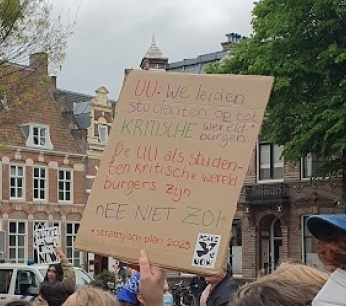
'Guideline protesting universities and colleges is too far-reaching'
Trade unions are 'seriously concerned' about the joint directive from universities and colleges following the protests. It goes against the right to demonstrate internationally.

Image: Pixabay
AOb-University sector manager Donald Pechler: “We still see too many snags in the proposed guideline from universities and colleges. The right to demonstrate is limited unilaterally and we see too few indications of how this can be carefully facilitated. Moreover, employers should first discuss a new guideline carefully with the unions and management bodies of the institutions. We therefore call on mrs not to cooperate with this proposed directive.”
The unions recently sent a letter to the Universities of the Netherlands (UvN) and the Association of Universities of Applied Sciences (VH), the employers in these educational sectors about the right to demonstrate. The unions felt compelled to respond the previous statement of the colleges and universities on their sites.
Directive
In it, higher education administrators let them know what is and is not allowed during protests in and around their buildings. VH chairman Maurice Limmen emphasizes in the press release that demonstrating remains possible at colleges and universities, but points demonstrators to the joint guideline that has been drawn up stating which rules must be observed. 'Universities and colleges also find it important that everyone can feel safe on campus,' he said to be read in the directive.
The employers state their principles during protests. For example, they do not want people to spend the night on campus or occupy a building. They also always want to negotiate with people whose faces are clearly visible. Furthermore, protests must be registered in advance. 'So that agreements can be made about how a protest takes place.' The guideline also states that participants in protests must always be able to identify themselves with an ID card or employee pass.
Far-reaching restrictions
The unions believe that this directive goes a step too far. "Unfortunately, we see too far-reaching restrictions on the right to demonstrate, which can make critical voices and substantive debate more difficult," said the unions that would have liked to contribute ideas about the directive.
Unfortunately, we see far-reaching restrictions on the right to demonstrate, which can make critical voices and substantive debate more difficult
Registering a protest action at educational institutions is an issue for which the unions see no legal basis. You register a demonstration with the mayor, so that you can make agreements about the course of a demonstration. "The law does not require reporting to the organization against which the demonstration is taking place," the unions said.
Occupying a building is not necessarily prohibited, the unions believe. If you want to ban this, 'necessity, proportionality and subsidiarity' must be examined per situation. The directive ignores this, the unions believe. The same applies to staying overnight on a campus. 'General prohibitions detract from the complexity and nuance.' Asking for identification of the demonstrators 'creates a feeling of insecurity'. Employees with a temporary contract may drop out, the unions think.
Critical Sounds
The current directive restricts the right to demonstrate too far, write the unions. The employers' directive still takes insufficient account of international law, the constitution and good employment practices. Pechler: “We would like to discuss with employers to arrive at a good national guideline, which takes into account the matters mentioned above.”
Ceasefire
De AOb does one renewed call to the ceasefire in Gaza, and also calls urgently on the Israeli government to put an end to the destruction of the education system in Gaza. The AOb is concerned about the destruction of the educational infrastructure: all twelve universities have been destroyed, most schools severely damaged. Thousands of pupils, students and hundreds of teachers have died. The AOb stands for good education throughout the world.